Freshman year of college can be difficult in all sorts of ways. Homesickness, imposter syndrome, and mental health issues are just a few of the troubles plaguing first years students. However, finding a sense of belonging within a community can play a key role in alleviating these issues. For this project, our team explored ways to promote enculturation earlier and more effectively among first year Purdue UX undergraduates.
OVERVIEW
PURPOSE
Course project for Purdue UXD Graduate Studio 1
OBJECTIVE
“Cut through the noise” of information new Purdue students receive by reaching out to them consistently and directly over the summer months in order to encourage community engagement and a sense of belonging.
APPROACH
Building upon current communication efforts and established cultural practices, our team designed a print postcard and an online guidebook, coupled with an email campaign, to relay information to new UX students. The emails and guidebook promote community and participation through the use of several channels including PXD (Purdue’s UX club) Discord and Slack.
PROJECT DURATION
Four weeks. October 26, 2020 – November 30, 2020.
TEAM MEMBERS


Portfolio | LinkedIn
FINAL DESIGNS
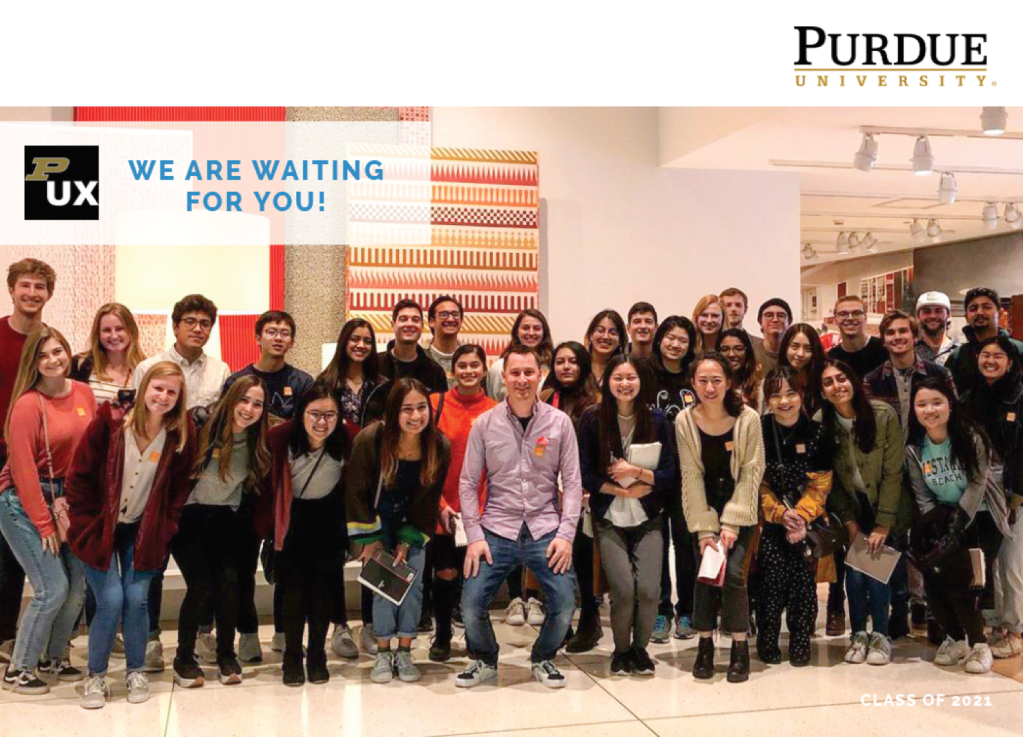
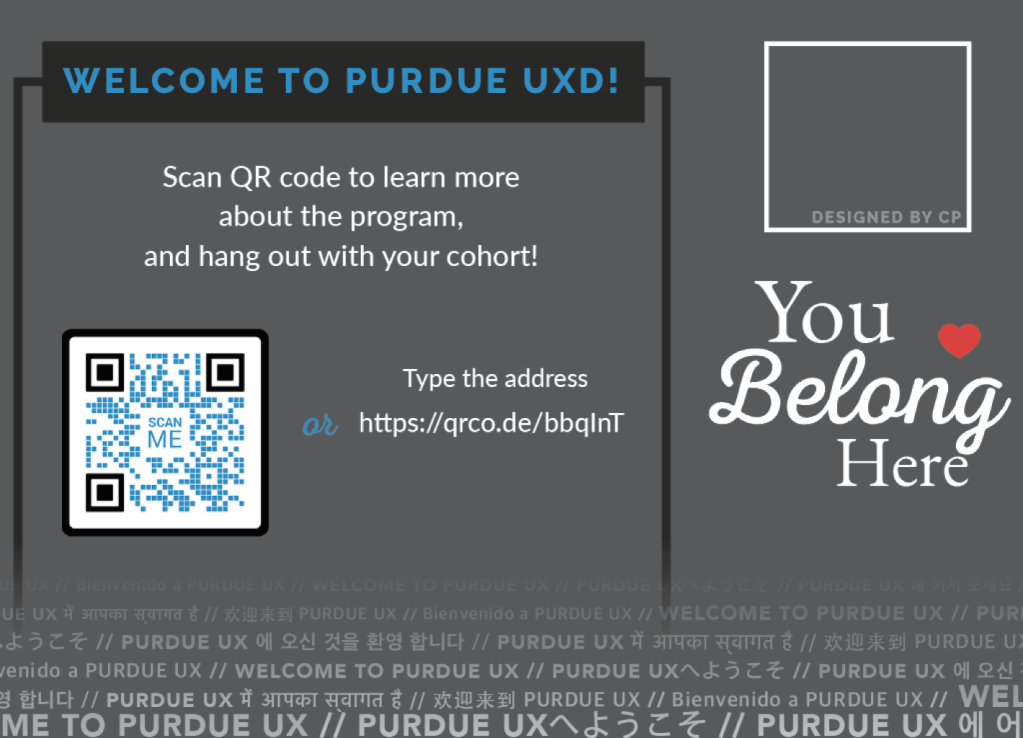
Postcard design featuring QR code linked to online guidebook.
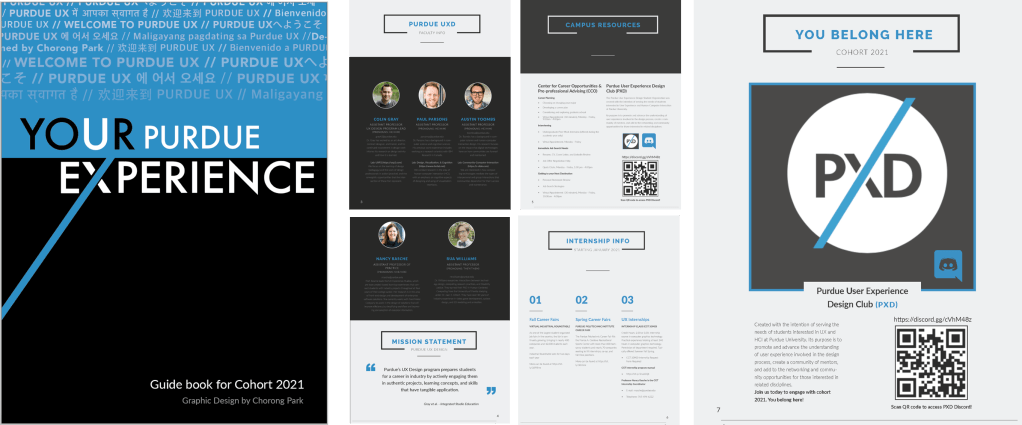
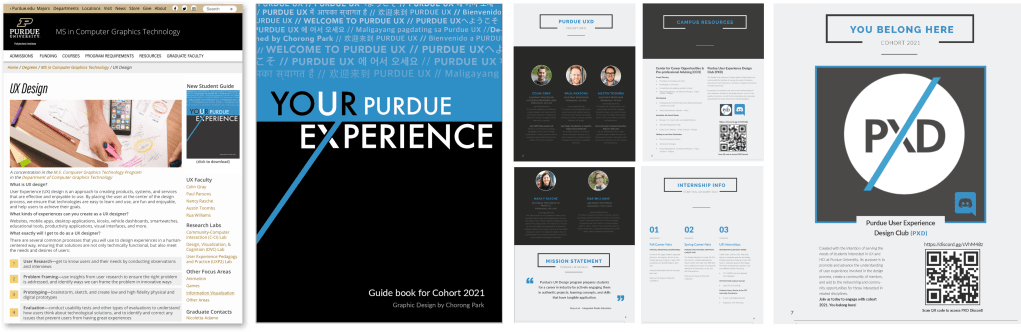
Sample pages of digital guidebook that includes faculty, resources, internship information, Slack and Discord links, and more. (link to full version)
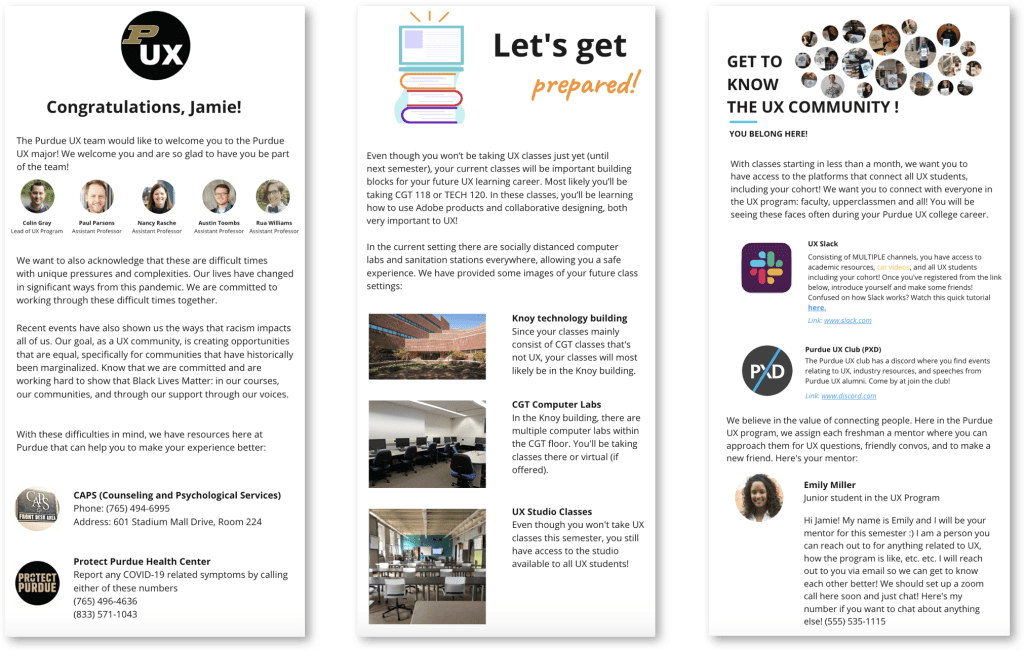
Email campaign to onboard new students, adapted from current email sent to first year students
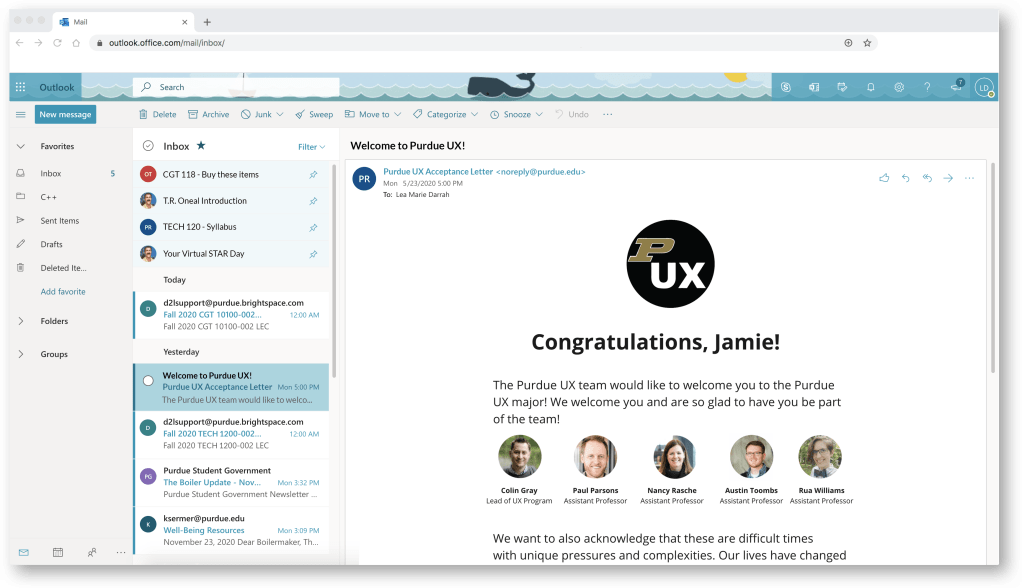
Email #1 – welcoming new students and includes information about faculty and staff, plus useful resources.
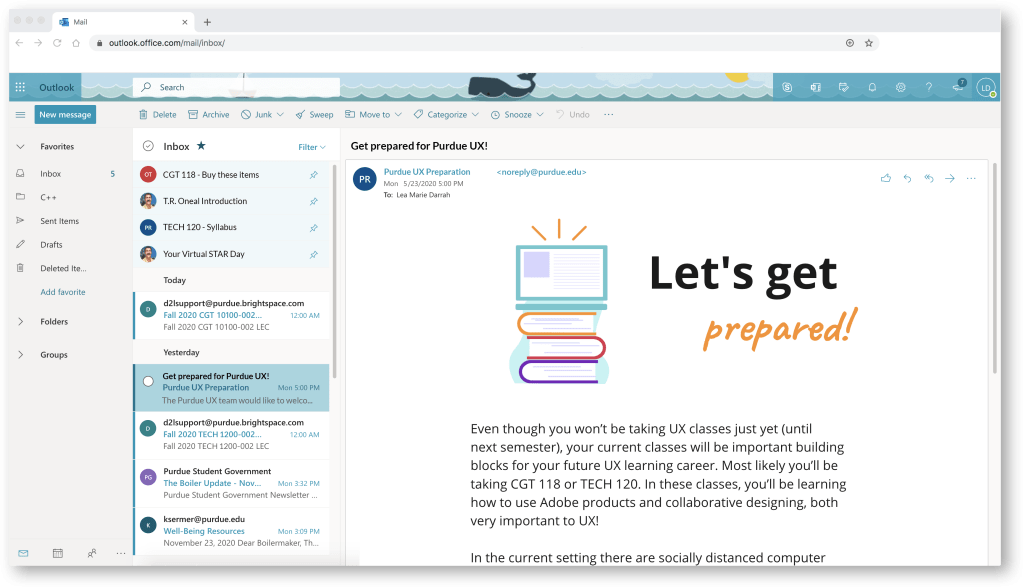
Email #2 – informing students about class settings and COVID guidelines.
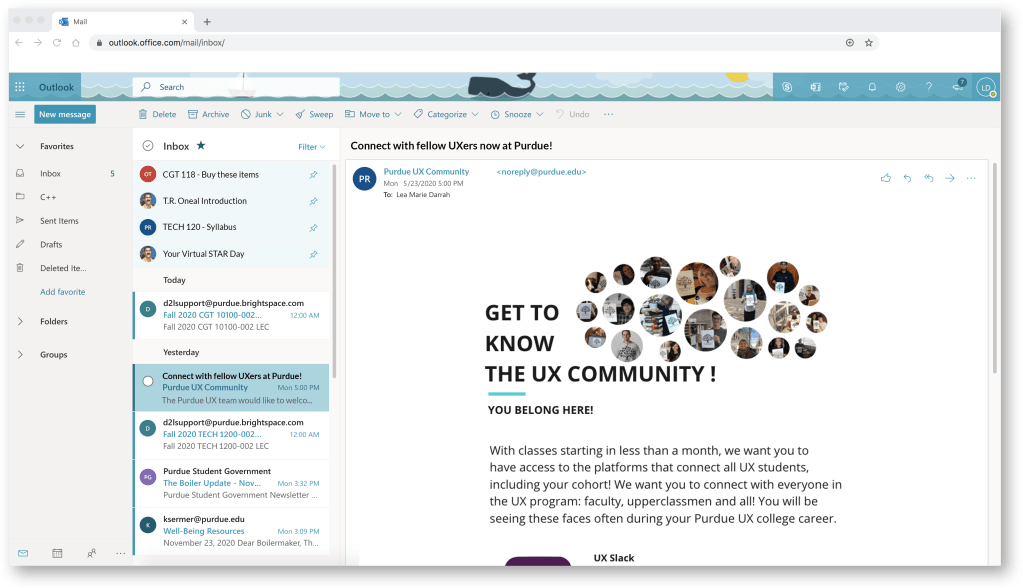
Email #3 – informing students about UX community platforms (Slack, Discord) and mentor introduction.
UX PROCESS
RESEARCH
Our team started by learning more about the importance of enculturation and its effects on students, Enculturation has shown evidence to increase coping skills related to academic-related stress and have better resilience against stressful life circumstances [2]. Given the current stress and anxiety of the COVID era, supporting the well-being of students is a priority.
In addition to this, the Purdue UX community is a growing community of practice. Our research revealed that “borders define who belongs to the community [of practice] and who does not” [1]. These same borders “enable emotional security, which allows members to freely talk about their feelings and needs [3][4]. New students needed to feel like they belonged in the UX community in order to be comfortable and engage in social interaction.
Considering the multiple factors freshman students need to focus on over the semesters, we considered implementing enculturation practices in a relaxed and casual manner, especially during the summer transition.
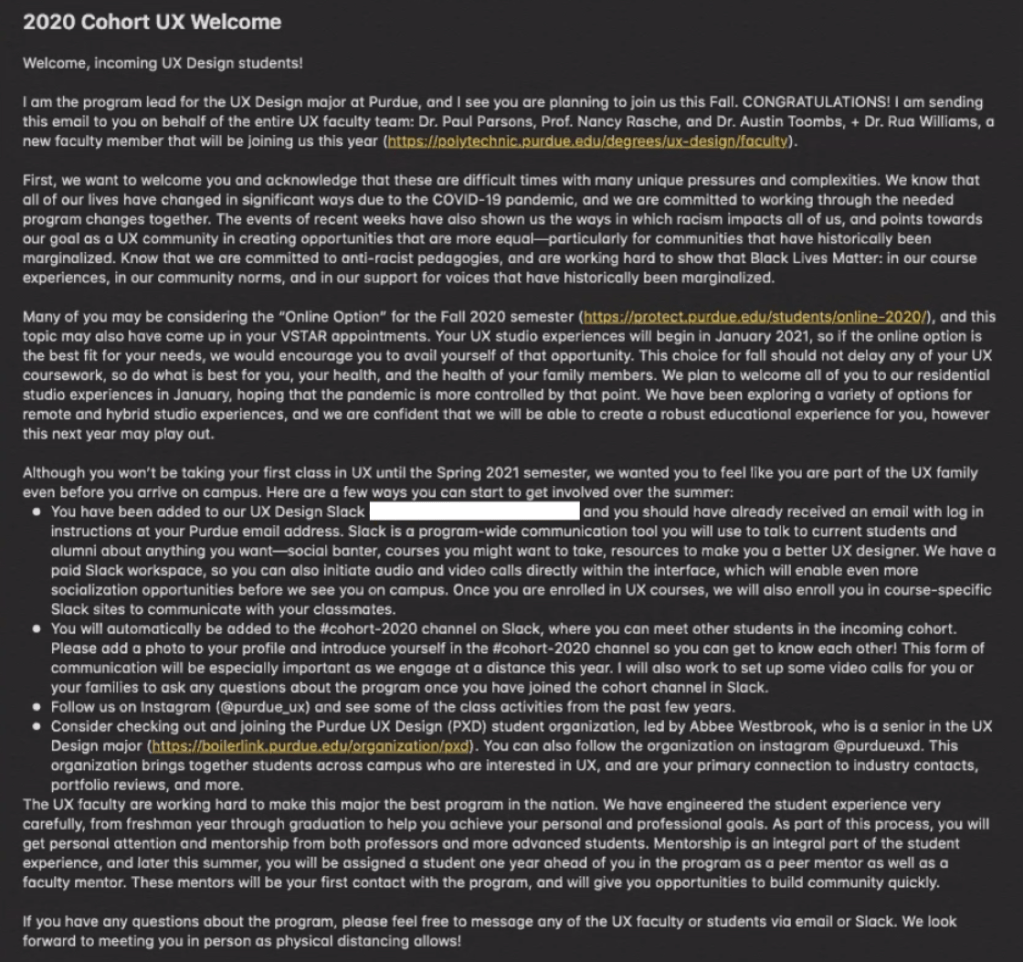
We interviewed three first year UXers at the beginning of our project cycle in order to gain a better understanding of their experiences. Currently, first year students receive one email early in the summer from Dr. Colin Gray. The email contains information about the Purdue UX program including faculty, current events, online courses, Slack, and PXD Discord. This email went mostly unnoticed by our three interviewees, opening up our first window of opportunity.
[My friend] wasn’t aware there was a Slack. And I just kind of thought everyone was in it. So I sent her the link and I sent her Colin’s email, because I couldn’t figure out how to add right her or if I had that permission. But that’s how I’ve been getting all my [Purdue UX] news.
– First year Purdue UX student
We noticed our interviewees were confused about the resources provided to them initially and others found Slack was not relevant to their current studies. With this in mind, we aimed to create awareness of the resources and program rather than drive them towards immediate engagement. We hoped to create a space for them to process the upcoming year, gradually provide information about the program, and grant them access to UX resources such as Slack.
CO-DESIGN SESSIONS
Our team, along with two other teams working on different stages of this project (early fall, late fall), orchestrated three separate co-design sessions, consisting of first years/CODOs, undergraduate upperclassmen, and “beyonders” (graduate students, graduates). The sessions reinforced our ideas about designing a multi-step welcome program. These sessions were their own form of enculturation as well. The majority of participants had never met the facilitators. By including first year UXers in this process, we saw increased activity on Slack channels in the weeks that followed.
IDEATION
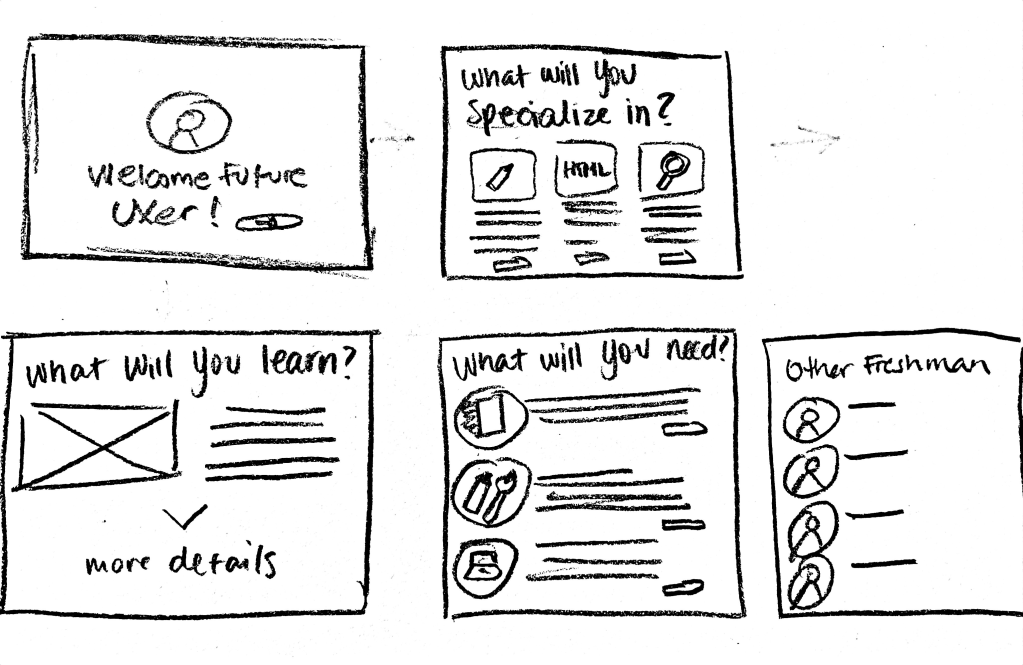
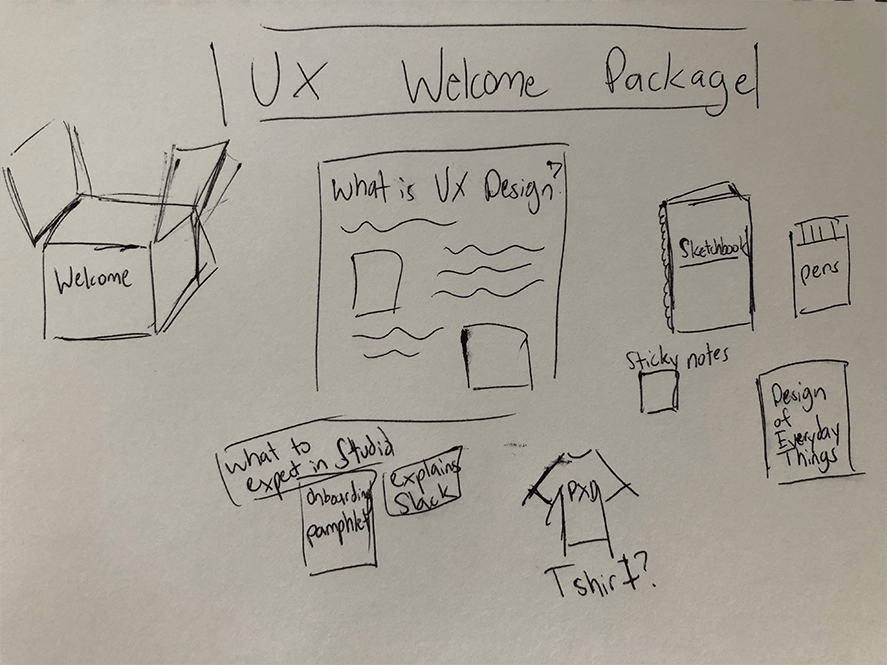
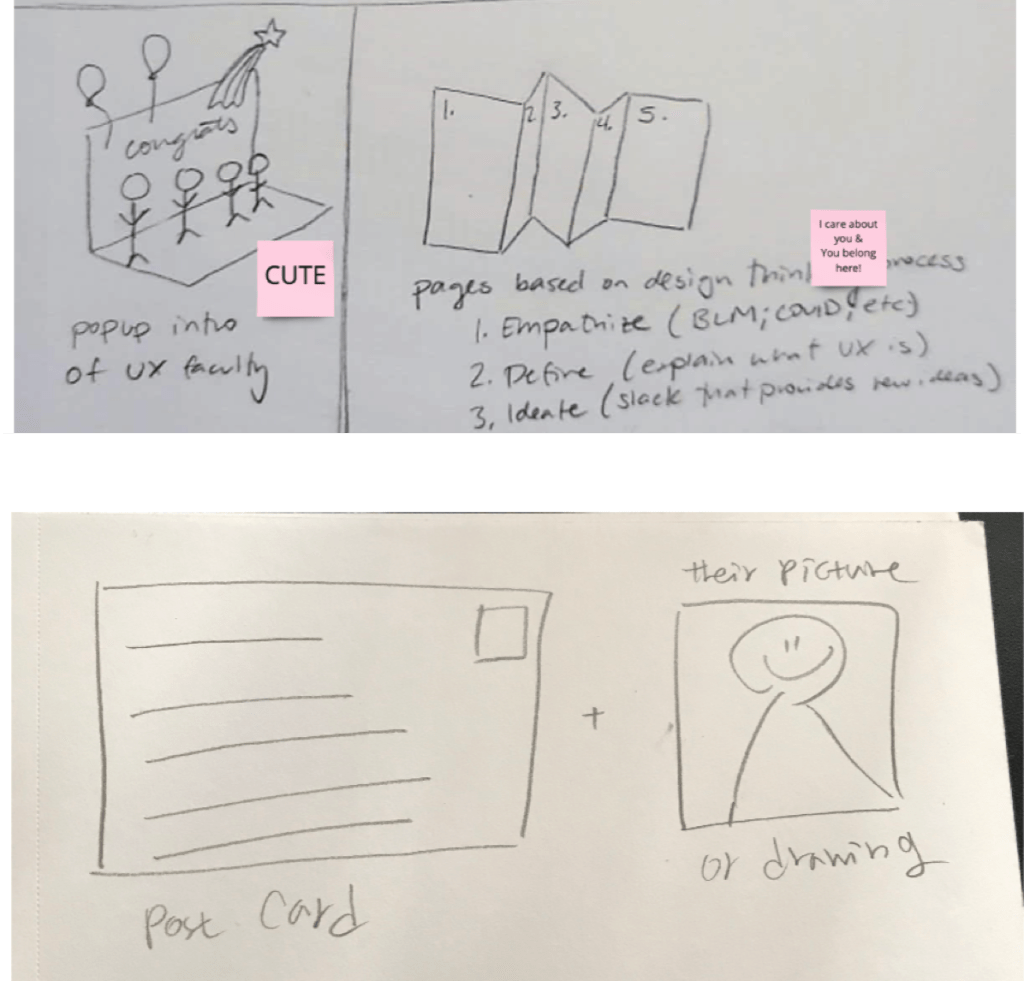
We explored a variety of brochure and guidebook ideas, including sketching die-cut versions, pop-up card versions with the UX faculty, and a postcard that would encourage students to send back picture which could be included on an online UX directory.
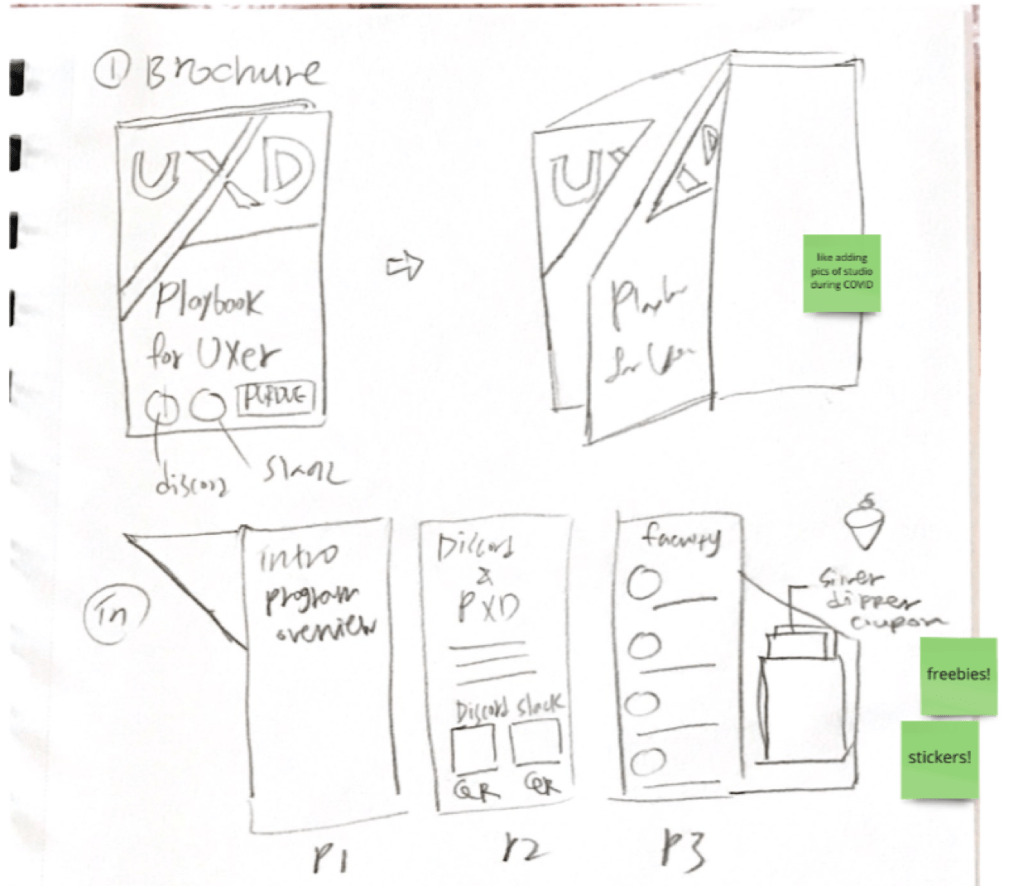
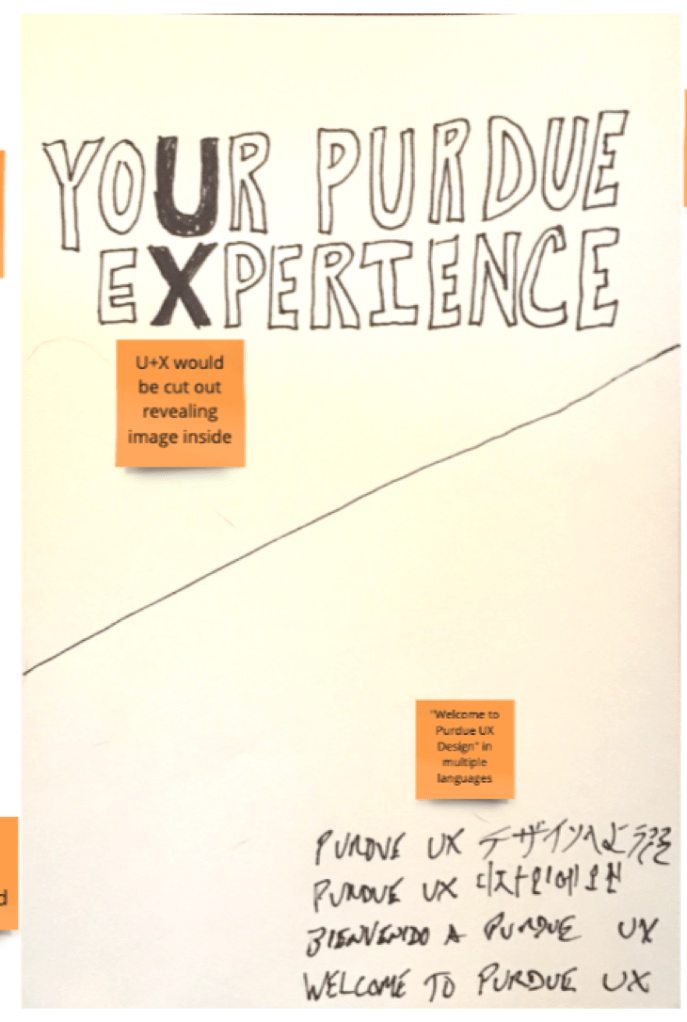
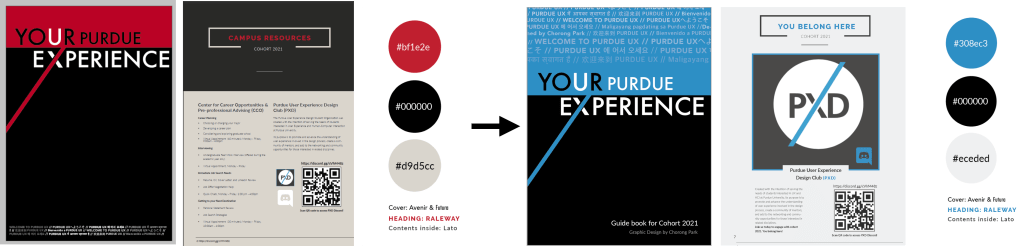
The first high-fidelity version of the guidebook was updated after receiving feedback from teammates. The color combination of the first version (left) had low accessibility, so we changed colors and some layout elements (right) to improve this.
Finally, we knew we wanted to retain some email elements, even if all new students didn’t read them. We went back and forth on how to divide the current email and settled on three, one per month. This allowed us to distill the information into digestible pieces without overwhelming new students. We sketched out ideas that had more graphics and moved away from the “wall of words” currently used in order to capture and maintain the attention of recipients.
EXPERIENCE MAP
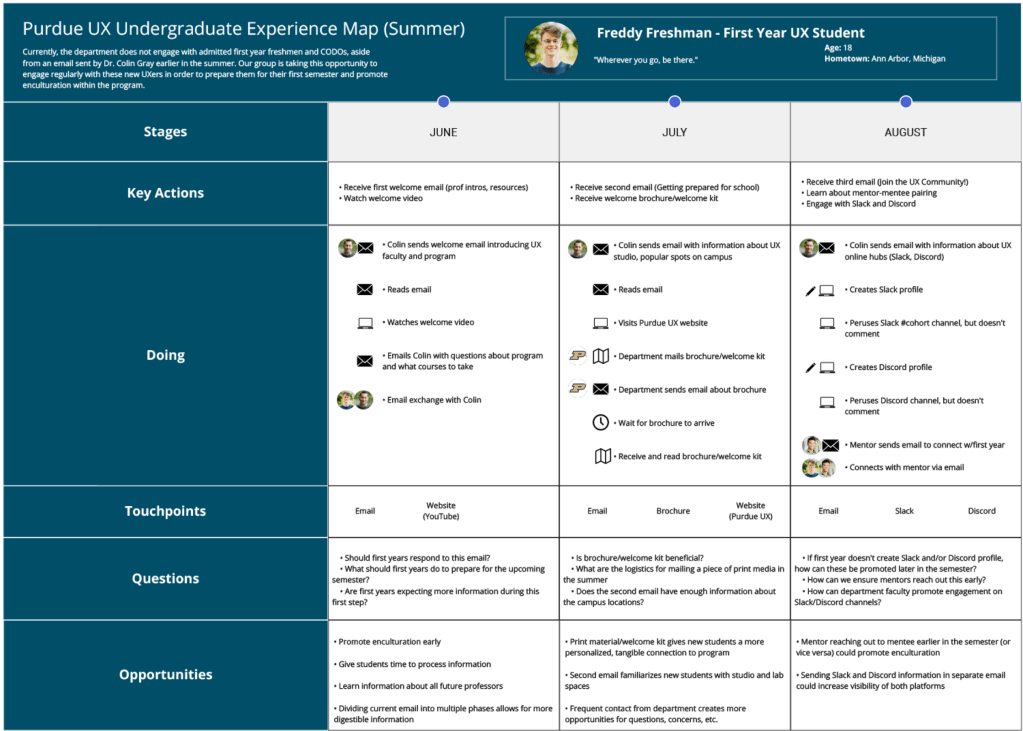
Experience map detailing key actions and touch points during the summer months leading up to first semester. Some of our initial ideas included a welcome video recorded by all members of faculty, a “UX Welcome Kit” that would include branded sketchpads, pens, and stickers, and a printed brochure. These were omitted later in favor of a streamlined email + postcard + digital guidebook approach.
REFINEMENT
We invited first year UX students to one of our final design critique sessions in order to get a first-hand opinion on our fleshed out designs. During the session, these students confirmed that a site (or in this case, our guidebook) would be a useful “one stop shop” for students seeking information. We were informed this design could be easily incorporated into a Purdue UX microsite as well, which is currently in the works.
This session gave our team the opportunity to defend our ideas as well. When questioned about the alternative options to a fully-printed guidebook, we noted that we had previously sketched an idea for a postcard which we could easily link to an online version of the guidebook. Also, when discussing how younger college students use email and their formal view of the medium, we argued how our approach took the current email and broke it into a three step campaign, with each one becoming less formal and more conversational. We scheduled the initial interviews for this project via email as well, so there is evidence that new students check their inboxes.
With this feedback in mind, the next step was to construct our prototypes.
“As incoming students we’re inundated with 70 different things. But it would just be super easy to open a site [and] bookmark it, rather than having to search for an email with all the information.”
Sarah, Purdue UX first year student
PROTOTYPE
We aimed to gradually ease the flow of information through email which transition from formal to informal communication. We evaluated the original email to see what topics were the most important to cover and decided to split the email by the following three topics: welcome, class expectations, and UX community.
Building off earlier versions and critique feedback, we finalized a guidebook that can be utilized in both print and digital forms. Digital files could be easily updated by faculty and/or staff and/or PXD to accommodate any future changes to faculty, curriculum, etc.
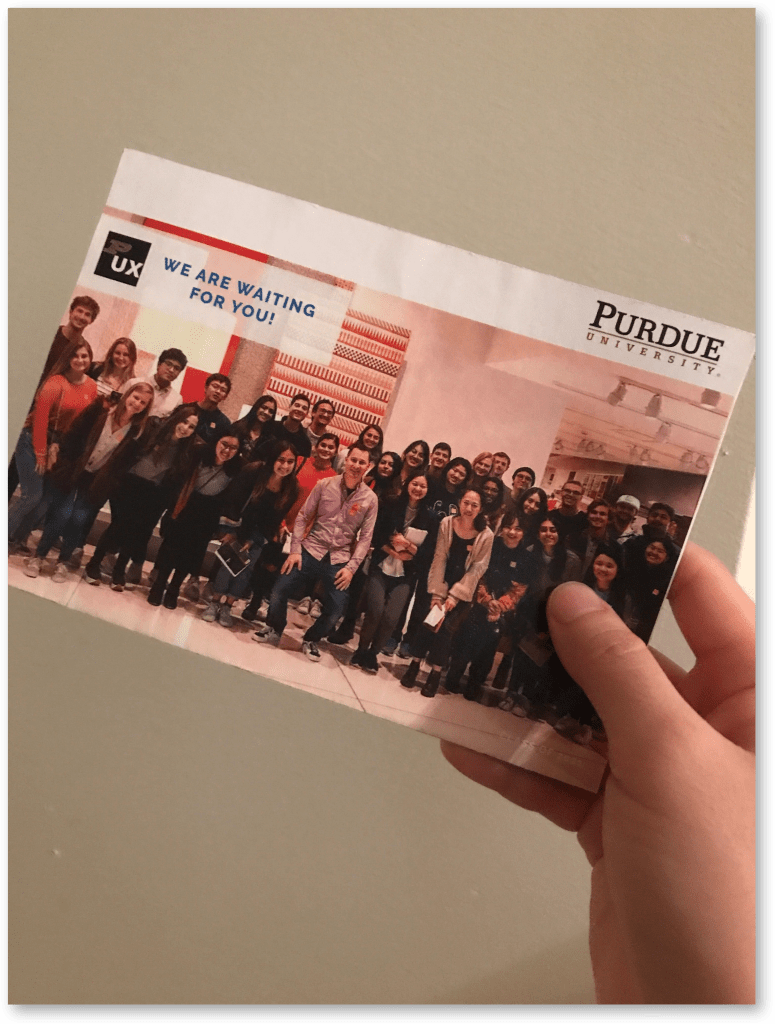
Finally, we created a postcard prototype which was used in a class demonstration video. The front of postcard (first image) features photograph of recent Purdue UX undergraduates while the back of postcard (second image) features a QR code that links directly to digital version of guidebook along with welcome message and “You Belong Here” tagline.
Finally, we created a postcard prototype which was used in a class demonstration video. The front of postcard (first image) features photograph of recent Purdue UX undergraduates while the back of postcard (second image) features a QR code that links directly to digital version of guidebook along with welcome message and “You Belong Here” tagline.

CONCLUSION & NEXT STEPS
Executing our design would require collaboration between students and faculty in order to ensure the most vital information is included in all pieces. While we included the information we found most pertinent for new UXers, opinions on this could vary. As discussed during the final critique session, our design could easily be added to the microsite currently in pre-production and our three-step emails could be scheduled to send in order to minimize extra work on unpaid faculty during the summer months. While the postcard would require some manual effort, we believe the ability to reach out directly via tangible, personalized media is not a lost art.
REFERENCES
[1] Diekamp, O. (2007). Interpersonales Wissen und kooperatives Lernen im virtuellen Seminar [Interpersonal knowledge and cooperative learning in a virtual seminar]. Berlin: Logos.
[2] Holloway-Friesen, Holly. (2016). Acculturation, Enculturation, Gender, and College Environment on Perceived Career Barriers Among Latino/a College Students. Journal of Career Development. 45. 10.1177/0894845316668641.
[3] McMillan, D. W., & Chavis, D. M. (1986). Sense of community: A definition and theory. Journal of Community Psychology, 14(1), 6–23.
[4] Wenger, E. (1999). Communities of practice, learning, meaning, and identity. Cambridge, UK: University Press.

 CHRISTOPHER WOLFORD